Thursday, December 29, 2005

Shopping for Health Care

A recurring motif here at InsureBlog is Consumer Driven Health Care. In general, this means avoiding plans with expensive �first dollar� benefits (such as $20 office co-pays and $10 prescription cards). By choosing plans with high deductibles, and using one�s insurance as a safety net for large claims, more dollars stay in one�s pocket. And, in many cases, result in favorable tax benefits, as well.
Inherent in this philosophy is the idea that consumers will become more pro-active in deciding how and where to spend their health care dollars. For example, Provider X charges $100 for a mammogram, while Provider Y�s is only $85. Assuming equal quality, why would one choose Provider X?
The challenge is that, for the most part, health care costs are like airline fares: one never really knows ahead of time how much a given service will cost, and different patients (with different plans) will pay different amounts.
Confusing? You bet.
Some carriers, like Aetna, are coming around, and making this information more accessible to insureds. But not all:
These mystery shoppers soon learned what most of us already knew: the folks at the doctor�s office rarely (if ever) knew how much the service or procedure would cost. In fact, less than a third of these shoppers could get firm prices in a single call. I have no reason to suspect that it�s much different for actual shoppers, either.
Of course, this is a national phenomenon, not limited to the Golden State:
A survey by the Kaiser Family Foundation and USA Today found that 52 percent of people polled nationwide said their doctors never or rarely discuss the costs associated with the procedures they recommend.
Of further course, one wonders whether or not most patients ever ask about those costs. But those patients who�ve bought into the CDHC model, generally through Health Savings Accounts (HSA�s), probably do. I went poking around the net, but have thus far been unable to find a study of how many HSA�ers [ed: you just made up that word!] do, in fact, ask about these costs. In an admittedly informal and non-scientific survey, I asked some of my HSA clients whether they asked about these costs. To my surprise, only about half of them said they do.
Yet there is evidence that older �tried and true� treatments can be just as effective as the newest, at far lower cost. Now, your provider may have a very good and valid reason for suggesting the latest technology or purple pill, but that�s really another reason to discuss the issue.
Last winter, for example, my daughter experienced the thrill of a kidney stone. I am assured that this pain is second only to that of childbirth, and seeing her retching, I can believe it. At the hospital, a very brusque resident put her on the fast track for a certain procedure, somewhat akin to an ultrasound, but more invasive. He was quite taken aback when I called an immediate halt to the proceeding. �But she must have this procedure,� he exclaimed. �Fine,� I replied, �please explain to me why it is preferable to the old sonic blast method.�
Which rendered him quite speechless.
My point was that, before we go for the latest tech, let�s examine the options for both cost and efficacy. Eventually, the chief urologist came in to explain, to my satisfaction, why this procedure was, in my daughter�s case, superior and ultimately, more cost effective. At which point she underwent it, and has been quite the happy camper since.
The lesson here is not that I don�t care about my daughter�s welfare, but that I wanted to be an informed consumer. The resident was apparently unaccustomed to having his word (or authority) challenged. But that�s really the point: if we are to be informed consumers, we have to act as informed consumers.
Judy Rupp, information and assistance case manager with the Northern Oklahoma Development Authority Area Agency on Aging, recently wrote:
Couldn�t have said it better myself.
UPDATE: Hospital Impact blog has another take on this subject. Recommended.

Wednesday, December 28, 2005

Another Ethical Question...

We have an acquaintance who has a medical condition which requires surgery. Complicating matters is the fact that she is currently planning to establish residency in another country. She is currently in that other country, but cannot afford to have the operation there. Since she is still an American citizen, an alternative she is considering is to temporarily move back here where, due to her circumstances she will be eligible for Medicaid, which will pay for the surgery. She would make the permanent move overseas once she recovers.
A more accurate statement would be: �to temporarily move back here where American taxpayers would fund her operation, after which she would move overseas.
A still more accurate statement would be: �to temporarily move back here where you and I would pay for her operation, thus enabling her to move overseas.
As one who promotes and encourages personal responsibility, I have a problem with this. We give the State the power to take our money and give it to someone else (or to pay for services on their behalf). Is it �right� that the State will take our money to pay for such services on behalf of one who will then move (permanently) to another country?
Your thoughts?
[NB: I would prefer not to discuss the whole issue of Medicaid (and other such mechanisms) paying the cost of health care for persons here illegally; I understand that the issues are related, but I�d really like to focus on this specific situation.]

Investment Banking Downturn in 2006?

The Financial Times, Lex, 28 December 2005At the world's investment banks, 2005 will be celebrated as a vintage year. Merger and acquisitions volumes and equity markets have revived while the fixed income boom has continued beyond all expectations. Many markets experienced ideal trading conditions, with big, well-flagged movements - for example, in US interest rates.In the traditionally slow

Tuesday, December 27, 2005

Post-Christmas Carnivals

For an interesting look at the medblogosphere, Grand Rounds is up at The Health Care Blog. Host Matthew Holt has a slew of great links. Two of our favorite MedBloggers, Elisa of Healthy Concerns and Kate of Health Policy, have interesting articles.
The Carnival of the Capitalists is hosted this week by Josh Cohen of Multiple Mentality.

US Financials Took the Lead Late in 2005

Barron's, Getting Technical, Michael Kahn, 27 December 2005each yeat, at this time, pundits take a look back to see just how right they were (they are never wrong, of course) in their predictions for the year.For the financial media especially, it is a way to find meaning in what is normally a low-volume, low-interest time of year as traders and investors leave for the holidays.Of course, Getting

Friday, December 23, 2005

Cdn Banks Post Solid Profits in 2005 Despite Enron Charges

Canadian Press, Rita Trichur, 24 December 2005Toronto (CP) - The Canadian banking industry got sideswiped by the Enron scandal in 2005 after three of the country's six-biggest banks took billions of dollars in charges for their liabilities in related lawsuits.Nevertheless, the industry affirmed its resiliency by mustering record profits as vigorous mortgage and consumer lending, along with

Thursday, December 22, 2005

RBC Expects US Bank and Thrift M&A Activity to Accelerate in 2006

SNL Financial LC, 22 December 2005RBC Capital Markets' commercial banking research team delivered its forecast for M&A activity in 2006, saying that they expect activity to pick up after a slow 2005 because of the "completion of the 'digestion phase' of the acquisition cycle for selected acquirers," a coming slowdown in earnings growth and regulatory burdens starting to ease.RBC noted that based

Wednesday, December 21, 2005

Takeover Potential Raises Value of Small US Financial Institutions

The Wall Street Journal, Ian McDonald, 22 December 2005The stocks of little banks have big price tags -- and vice versa. For the scads of investors holding shares of small community banks hoping they will be acquired by a bigger player, that could be a problem.When smaller banks trade at prices that are higher multiples of their per-share earnings than their bigger brethren, as they have for

A Taxing Post...

Important, useful information.

Buy & Sell, Part 2

In Part 1, we saw the consequences of a business failing to plan for the demise of one of its owners. In Part 2, we�ll discuss why properly funded Buy-Sell Agreements (BSA�s) can be valuable tools to ensure the continuation of a business in similar circumstances.
The problem arises because the needs and goals of the heirs (typically family) of the deceased owner aren�t necessarily (or even usually) shared by the surviving owner or owners. The heirs want the maximum amount of dollars for their shares in the business, a prompt estate settlement, and an end to their anxiety about potential creditors. And, they�d like to settle the issue of the business� value for estate taxes.
On the other hand, the surviving owners would like to minimize their costs for transfer of ownership, while moving that transfer along as quickly as possible. Usually, they also put a premium on regaining full control of the business, free of (often meddlesome) family who have no experience in it.
The challenge is that, absent some formal, written contract that spells out and addresses each of these concerns, neither party gets their wishes, and the business often dies, too.
The first part of the solution is a written agreement which provides for an orderly transfer of the business at a mutually predetermined price, a method of valuing the business that will satisfy the IRS, and stability for the business, its staff and its creditors. Obviously, it�s far more effective for this to be in place beforehand.
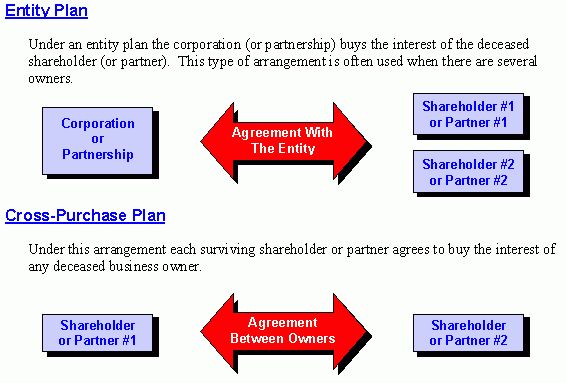
There are two basic �flavors� of BSA: Entity Plans and Cross-Purchase Plans. Each business must determine which of these is most appropriate for itself (click on graphic to enlarge):Once an agreement has been produced (with the help of the attorney and the accountant), it�s necessary to fund it. Why? Well, here�s the thing: all the best intentions aside, just because there is a mechanism (the BSA) in place to facilitate an orderly transition, if there�s no way for the surviving owners (or the business itself) to pay the transition costs, then the whole exercise was a waste of time.
There are several ways to fund a BSA. The ideal solution would be relatively inexpensive, easy to administer, and wouldn�t interfere with the day-to-day operations of the business. In general, there are four funding alternatives:
� Cash
� Loan(s)
� Installment
� Insurance
Let�s tackle these one at a time.
The problem with paying cash for the deceased's interests is that there�s no way to know when it�s going to be needed: what if an owner dies tomorrow? Such funds must be put aside after taxes, and thus become somewhat expensive. There�s an opportunity cost: money put aside to fund this potential future liability are unavailable for other business uses, such as expansion or capital improvements.
If a principal dies, how easy would it be for a company to access additional credit? Even if sufficient funds can be borrowed, the additional debt is another burden facing a wounded company.
�Installment� means paying the deceased owner�s heirs over time � maybe a long time. That may well be distasteful to the heirs, and it (like loans) can be a drag on the company�s ability to move forward.
Insurance, on the other hand, satisfies all three criteria: it is (generally) inexpensive, fairly easy to administer (just remember to pay the premiums on time), and provides an immediate infusion of cash to settle debts and allow the company to have a chance at recovery.
These two �legs� � a written agreement and the funding to enable it � may well have resulted in a different, better holiday season for our jewelers.
For more on Buy-Sell Agreements and related issues, I recommend Allison Consulting's estate and business law blog.

Monday, December 19, 2005

Carnival Time!

A distinctly "Saturday morning" feel to this week's entries:
? Host Warren Meyer of Coyote Blog (as in Wile E.) brings us the Carnival of the Capitalists. Be sure to check out his offbeat "advertisements."
? And the Carnival of Personal Finance is up at Political Calculations. Ironman presents this week's installment in a uniquely useful "dynamic table" format.
? And for the best of the Medblogosphere, be sure to stop in at Grand Rounds. This week's episode is at MedPundit. This one has a Dickensian feel to it.

From the Peanut Gallery...

One of our commenters took issue with us regarding what happens when a group health plan is disbanded (that is, goes away altogether). Rather than address this in the comments section, it seems more helpful to explain the ramifications as a separate post.
In my reply to the commenter, I said that if the group was cancelled, �COBRA (and/or state-mandated continuance) is not available.
I should probably clarify that little nugget: "and/or state-mandated continuance."
In Ohio, we have a state law which we lovingly call "mini COBRA." In certain circumstances, an (ex-)employee may elect to continue their group cover for an additional six months. Obviously, if there is no longer a group plan in place, this option is not available; it was to this benefit that I referred.
Also under Ohio law (YMMV), most group plans must offer a "conversion" plan with no exclusion for pre-existing conditions. Unfortunately, these can be quite expensive, and offer minimal coverage. Still, they may well be �better than nothing.�
There is also a mechanism available through HIPAA (which, BTW, is not the same as �Hippa,� which is a Greek word referring to �Eve�) which allows an uninsurable person to access a state-mandated benefit plan. This, like the conversion plan, would cover pre-existing conditions, but with correspondingly higher premiums.
Interestingly, we covered this ground back in March, and I recommend that post to those interested in a case study of this method.

A Fresh Start at AIG

Barron's, Jonathan R. Laing, 19 December 2005It has been a tumultuous year for insurance giant American International Group and its shareholders. But better times are coming for both of them.For one thing, AIG's franchise, at home and abroad, seems as sound as ever. For another, its new leaders have been cooperating with ongoing investigations into abuses in the insurance industry, something that

Sunday, December 18, 2005

Prudential Investing in No. 3 China Insurer

Reuters, George Chen, Sun Dec 18, 2005 11:56 PM ETShanghai, Dec 19 (Reuters) - U.S. buyout firm Carlyle Group, one of the biggest foreign investors in China, said on Monday it would lead a $410 million investment for a quarter of the third-largest life insurer in the fast-growing mainland market.In a long-expected deal, Carlyle said it would buy a 25 percent in China Pacific Life Insurance with

Friday, December 16, 2005

A Ray of Hope (Anthem vs Premier)?

UPDATE (12/22/05): Just received this announcement: "Anthem Blue Cross and Blue Shield has reached an agreement with Premier Health Partners in Dayton, effective January 1, 2006." I'll have a bit more on this shortly.
Maybe; according to this article in the Dayton Daily News, Anthem and Premier �are talking at length again after nearly a year � expressing guarded optimism about the outcome.
What�s really interesting is that the DDN story is the only source for this information, which leads me to view it with some skepticism. That�s not to say that it couldn�t happen, but if substantive negotiations were taking place, one would expect to see multiple �leaks.� After all, these are the two largest players in the local health care market, and any forward movement in their tempestuous relationship would be newsworthy.
Of course, even if it is true, cautious optimism is in order:
(F)rom the perspective of members, I'd hate to get somebody's hopes up," Anthem spokeswoman Kim Ashley warned. "We do not have a definitive, signed agreement."
No kidding.
On the other hand, Premier may want to reconsider reconsidering:
According to the physicians, Anthem now "blends" (whatever that means) codes for different services in order to arrive at a lower reimbursement level. Anthem claims that this new method will actually increase how much they'll pay out.
I know which way I�d bet.
UPDATE (12/21/05): According to my Anthem sales rep, negotiation is ongoing. As noted above, however, there has been no resolution. Interesting.

Scotiabank Move May Have Rate Impact in Peru

Reuters, Teresa Cespedes, 16 December 2005Lima, Peru -- Moves by Canada's Bank of Nova Scotia and Britain's HSBC Holdings PLC to set up shop in Peru's already crowded banking sector could spark a fall in interest rates and heat up the competition in the promising low-income loans segment, the country's banking superintendency said.Last week, Scotiabank, Canada's No. 3 bank by assets, agreed to

Analysts Say Buy of TD Waterhouse Still a Good Deal

AP, Josh Funk, 16 December 2005Omaha, Neb. (AP) -- More than a third of the nearly $2 billion online brokerage Ameritrade Holding Corp. plans to borrow to pay for its latest acquisition will go directly to the company's board and top executives in dividends.Yet despite the increase in borrowing needed to help pay the $6 per share special dividend -- offered to encourage shareholders to approve

Thursday, December 15, 2005

Shopping for Info...

A survey by UICI, a health savings account provider, indicates that consumers will not "shop" for health care online. Why is this interesting, let alone important? Because one of the fundamental tenets of Consumer Driven Health Care (CDHC) is that the consumer, well, drives the healthcare decision making process. He�s supposed to be involved, interested, and willing to invest his time and efforts in learning as much as possible about the costs and consequences of those decisions.
According to UICI, when it comes to car shopping, for example, 56% of shoppers consult the web for pricing and availability. And 44% of folks looking for a new computer also use the web to research their options.
On the other hand, only 22% of consumers use the web to choose new doctors, and even fewer (12%) of hospital patients used the Web to compare hospitals. It certainly isn�t for lack of resources: many carriers have web tools, and a lot of providers have websites chock full of helpful information.
Only a little more than a third of internet users said they were even aware that information comparing prices and quality of doctors is available online. And about a third also they were aware that this type of information is available about hospitals online.
Frankly, that�s pathetic. And no, I�m not blaming the consumer (well, not completely, anyway). It seems to me that if carriers are going to continue to push CDHC, and they are, then they�re going to have to do a better job of educating consumers about the resources that are available. And, of course, agents (this one included) could stand to put in more effort on that front, as well.
Of course, if one purchases such a plan, then one has already agreed to take a more proactive role in the health care process. This means taking the initiative in researching treatment and provider options and, whenever possible, treatment costs. It would be nice, for example, if Aetna expanded its transparency program. It would be nicer still if other carriers implemented their own.

Makin' the Cut...

*** VOTING'S OVER ***
WooHoo! Thanks to our readers, InsureBlog is a Finalist (one of only 15!) in the 2005 Weblog Awards (Best of the Top 5001-6750). Thank You!
You can see the results here.
Thank you so much for your support!

Wednesday, December 14, 2005

National Bank's Quebec-centricity tr�s Profitable

The Globe and Mail, Konrad Yakabuski, 14 December 2005Montreal -- His predecessor used to bemoan the "Pepsi factor" -- his words, not ours -- but National Bank of Canada's Quebec-centricity has been tr�s profitable for chief executive officer R�al Raymond.Canada's sixth-largest bank has finally outgrown the "also-ran" label that used to sum up its status when analysts compared it to the Big Five.

Tuesday, December 13, 2005

UK Consumer Spending on Banking Services

The Economist, 14 December 2005Allegations of market failure plague banks in their most profitable year everFor an industry that likes to think of itself as staid and grey-suited, Britain's banks have been getting far more attention than they would like. Last week the Office of Fair Trading (OFT), a competition watchdog, said that it planned to scrutinise the market for payment-protection

Death of a Salesman (and his business)...

When Bob Gross, co-owner of a local jewelry store, dropped dead of a heart attack this past July, his business died with him. Sure, it took a while, several months, in fact, for the store to succumb, but succumb it did.
A buy-sell agreement, and the means to fund it, would have saved the business, and its employees would not now � at the height of the Christmas season � be looking for jobs instead of gifts.
Such an arrangement would also have meant that his friend and business partner would not be left out in the cold, either, with no store and few prospects. And it would have also made a difference for his widow and children, who face the holidays without their husband and father, and without the income and financial stability he provided.
Interestingly, this was no fly-by-night, cut-rate jewelry clearinghouse: "We're not a discount jewelers, our clients wouldn't stand for it," Jaffe said.
So presumably finances were not the reason that the business was left unprotected. We may never know the reason, but it doesn�t really matter; what matters is that this was a problem that had a simple and generally inexpensive solution, but for lack of foresight, was left untreated.
Buy-sell agreements are tools businesses use to ensure that there is a smooth transition should one of the owners die: an orderly transfer of ownership, a mutually agreed upon sales price and terms of sale, and stability for customers, staff and creditors.
Such agreements are especially important when dealing with closely held businesses like Messrs Gross and Jaffe owned. Had one been in place, and properly funded, this business need not have died with its owner.
How simple is it to put together a buy-sell agreement, and how does one fund it? Click for Part 2

ScotiaBank Pays $390 million for 80% of Banco Wiese Sudameris SAA

The Globe and Mail, Sinclair Stewart, 10 Dec 2005Toronto � A large, bronzed water gun, fastened to a plinth and inscribed with a warm dedication, sits on the floor beside Robert Pitfield's desk. It's an odd decorative touch for a banker, but not quite incongruous, considering the other bizarre bric-a-brac in the room: a small stuffed Big Bird; a Caddyshack-style outsized golf bag; a cricket bat,

Monday, December 12, 2005

It's Carnival Time!

And Rob of the Sama Blog hosts this week's Carnival of the Capitalists.
Both offer interesting posts that can help save you money (especially this time of year!).
For the best of medblogging, mosey on over to Grand Rounds, hosted this week at Corante. Be sure to check out Healthy Concern's take on new facelift technology.

US Financial Stocks Look Golden in 2006

S&P, Beth Piskora, 12 December 2005S&P has upgraded the sector to "overweight," along with consumer staples and health care. One reason: The Fed may quit tighteningOn Dec. 8, Standard & Poor's upgraded its recommendation for the financial services sector to overweight from marketweight. "Financials look good to us fundamentally and technically," says Sam Stovall, S&P's chief investment strategist

Friday, December 9, 2005

The Game of Life...

Now takes even longer to play. But that�s a good thing.
Regarding our post about lower term insurance prices, commenter John F took us to task for missing one of the most important reasons for that cost reduction: life expectancy.
And he�s right; life insurance rates are based substantially on mortality tables, which tracks life expectancy among groups of people. In a recent study, the National Center for Health Statistics found that �(t)he US life expectancy has hit an all-time high at 77.6 years.� On the one hand, this will serve to exert downward pressure on life insurance rates, which makes purchasing life insurance easier to afford.
On the other hand, the same study found that �(h)alf of Americans in the 55-to-64 age group have high blood pressure, and two in five are obese.� Aside from the obvious health risks these two problems pose, it also means that, while life insurance prices may fall, qualifying for these less expensive plans could be more difficult. Since the margins on term insurance products tend to be razor-thin, you can bet that underwriting (that is, the process by which an insurer determines how medically fit you are, and thus your actual rate, not necessarily what the agent quoted) will become correspondingly more stringent.
There�s another potential problem lying in wait, as well: as a group, Americans are living longer, and that�s good. But that also means that high ticket items like Social Security and Medicare will be paying out more dollars for more seasoned citizens. And it also means that the 30 year term insurance policy you bought at age 45 may not last the rest of your life; what happens to your plans on your 76th birthday?
More food for thought.

Thursday, December 8, 2005

HSBC, Example of How Cdn Banks Missed the Boat

The Globe and Mail, Eric Reguly, Thursday, December 8, 2005Vancouver -- Ever the diplomat, Sir John Bond, the outgoing chairman of HSBC, the world's third-largest bank, politely declines to comment on the growth strategies -- or lack thereof -- of the Canadian banks. "Thirty-two million people have a finite demand for financial services," is all he'll say.When the stars align, banks are presented

Scotiabank has Eyes on the Road with GM Deal

The Globe and Mail, Andrew Willis, Thursday, December 8, 2005The rest of the Canadian banking community just doesn't get Bank of Nova Scotia's fascination with lending companies money.Providing credit to corporate customers is a lousy way to make a living, according to conventional wisdom. The future is in retail banking, where bankers can provide high-margin wealth management to the masses,

Wednesday, December 7, 2005

Coming to Terms...

While health insurance costs continue to climb, there is good news on the life insurance front: term insurance rates continue their downward trend, which can be good news for consumers.
One reason for this is that, as a whole, sales of life insurance are down across the industry. One measure of this is �policy count;� that is, the total number of life policies written in a given year, irrespective of the face amounts or premiums. Compounding the problem is that average policy size is also much lower than one would expect.
Since the law of supply and demand applies no less to the life insurance business than any other, it stands to reason that insurers would like to make buying life insurance more attractive.
Of course, lower price is one way. But equally important is the purchase process itself: much like obtaining a mortgage, buying insurance can mean a daunting array of paperwork, and a seemingly endless underwriting process. To minimize both, carriers have finally come into the 20th century (that�s not a typo): electronic applications and fewer health questions help to speed things along.
Another trend is worksite marketing: used to be, the blue collar market was served by companies that sold �industrial� policies. These were low face amount, inexpensive plan paid weekly to agents who came by one�s house to �collect the debit.� Of course, those days are gone, but the folks who were well-served by that system are not completely on their own. More and more carriers sell more standardized plans that can be deducted directly from one�s wages, much like the old weekly plans.
In any case, term life insurance really is getting better (at least for now).

UBS Adds TD to List of Top Picks

The Globe and Mail, Angela Barnes, December 7, 2005UBS Securities Canada Inc. has dropped Bank of Nova Scotia and Meridian Gold Inc. from its list of top picks and added Toronto-Dominion Bank and Agnico-Eagle Mines Ltd.In the energy sector, which the brokerage firm has as a "neutral," the choices are EnCana Corp. in the producer category, Suncor Energy Inc. among the integrateds and TransCanada

Monday, December 5, 2005

Early December Carnivals

� The Carnival of Personal Finance is up at Frugal Underground. This week's hostess, Sarah, chose an interesting format: by word count. And Believe It or Not, I'm not the wordiest!
� Adam at Techronization hosts this week's Carnival of the Capitalists. Be sure to check out Roth & Co's item on S Corporations (What's a Family?); you might be surprised by the definition.
� And Grand Rounds is hosted this week by Dr Charles. He's got a cool Norman Rockwell theme going on.

IVF in the News (Again)...

Back in October we took a pretty extensive look at In Vitro Fertilization (IVF) and insurance. The underlying premise of that article was that �IVF fails to meet the threshold of �medical necessity,� ergo it should not be covered by insurance.
Apparently, most employers (and their group carriers) must agree with that assessment, because
Ms Greenstein opines that �(w)e believe it's the right of people to try to build their families." Well, of course she � and her colleagues � are free to believe anything they�d like; the problem arises only because she apparently believes that it is also her right to force others to help pay for her treatment.
What bothers me about this attitude is that proponents of lifestyle-related benefits, whether they be for IVF or Rogaine, seem not to understand the underlying economic factors at work. For example, Connecticut recently became the 12th state to require coverage for IVF. This means that policyholders in Connecticut will now subsidize the cost of this expensive treatment, whether or not they want to do so. This effectively means that insureds will now see rates increase due to treatment for a lifestyle choice, not a medically necessity. Doesn�t seem quite fair.
Why, for example, would we cover IVF but not trans-gender or bariatric surgery? Both of these are lifestyle issues, as well, so why is it fair to exclude them? Each new covered benefit results in higher premiums. Is it Ms Greenstein�s contention that health insurance isn�t expensive enough? That doesn�t seem reasonable, or likely. But it is the end result of mandating coverage for treatments that are not medically necessary.

Goldman Sachs Compensation Scheme

New York Magazine, Duff McDonald, 5 December 2005It�s like buying a gift for the guy who has everything: What can you do to impress the boss for whom you�ve already been pulling all-nighters and all-weekenders? That�s the dilemma faced by thousands of investment bankers in New York every fall, when bonus season gets under way. Starting sometime after Labor Day and ending before Christmas,

Date Set for TD Waterhouse Vote on Ameritrade Deal

Ameritrade Holding Sets Date to Secure Shareholders' Approval to Buy TD Waterhouse Group UnitAP, 5 December 2005Omaha, Neb. (AP) -- Ameritrade Holding Corp. has set a special meeting Jan. 4 to secure its shareholders' approval to acquire TD Waterhouse Group Inc.'s U.S. retail securities brokerage business for an estimated $2.9 billion.Under the deal, Ameritrade shareholders would receive a

Moglia Trumpets TD Buy, Cash Dividend

Forbes, Greg Levine, 5 December 2005Caspar, Melchior, Balthasar--Moglia?Like the three Biblical kings, Ameritrade Holding Chief Executive Joseph Moglia has gifts to bring--after his merger triumph is cemented.Ameritrade Holding, which furnishes securities brokerage via Internet, wireless and other technological means, announced Monday that it's come to terms with TD Waterhouse. The latter is a

Prudential - Running out of steam?

The insurance giant's stock has been on a tear this year, but it'll be tough to keep it goingBy Shaheen Pasha, CNNMoney.com staff writer, December 5, 2005: 12:39 PM ESTNew York(CNNMoney.com) - You can call Prudential Financial the comeback kid.At the end of 2001, when other companies were shying away from the initial public offering market in the wake of the Sept. 11 terrorist attacks, struggling

MetLife Maintains 2006 Guidance

Insurer predicts revenue and earnings growth in 2006 but investors were hoping for raised guidanceBy Shaheen Pasha, CNN/Money staff writer, December 5, 2005: 1:59 PM ESTNew York (CNNMoney.com) - MetLife Inc. expects to post 2005 earnings of $4.27 to $4.32 a share and 2006 earnings of $4.25 to $4.50 a share, driven in part by the insurer's acquisition of Citigroup's Travelers Life & Annuity and

Friday, December 2, 2005

Interesting Links for the Weekend...

� We've talked about "chutzpah" before, but Joe Kristan at Roth & Co writes about a fellow who not only defrauded the California Medicare system (to the tune of $40 million), but decided he didn't need to pay taxes on his ill-gotten gains, either.
� In my previous two posts, we talked about overweight Americans. Well, Elisa at HealthyConcerns has a disturbing post about the other side of that coin, anorexia.
� And David at the Health Business Blog tells us about the latest in "consumer driven" care: some insurers are apparently using graphic videos to discourage consumers from (over?) utilizing certain services.

Thursday, December 1, 2005

Sensing a Theme...

In my last post, we looked at the importance of exercise in maintaining good health. But why is this so important, and why are we talking about this on an insurance blog?
Well, one aspect of insurance has to do with mortality and life expectancy, both of which are directly affected by one�s general health:
Now, I�m not normally a �chicken little� kind of guy, but this is important information, and it affects my clients, their families, and all ther kind folks who frequent this blog. One of the doctors at the conference warned that �(f)or the first time in history this generation of children may not live as long as their parents because of lifestyle choices.�
This is of a piece with an article brought to my attention by my colleague, Bob Vineyard: �Fatter rear ends are causing many drug injections to miss their mark, requiring longer needles to reach buttock muscle.� Regular, standard sized needles are often too short to reach past the layers of fatty tissues, and allow the needed medications to get into the bloodstream. This is actually a double-whammy, because it can lead to irritation and even infections. My only real quibble with this study is that it was limited to a very small test group: 25 men and an equal number of women. I�d prefer to see a larger sample size [ ed: you just had to say that, didn�t you?].
In any case, the population that may be most in danger is our children. More and more young people are overweight, which has led to an increase in diabetes. From an insurance perspective, this makes it more difficult for folks to find affordable coverage later, if they can find it at all.
 
Copyright 2010 Insurance Information. All rights reserved.
Themes by Ex Templates Blogger Templates l Home Recordings l Studio Rekaman